Interview with EAVE producer Tibor Keser on Fiume o Morte!
"Films really are a collaborative effort, and EAVE gave us the tools and the connections to help make that real."
By Lilla Kadar
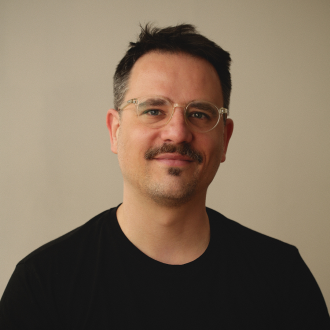
EAVE graduate Tibor Keser is a Zagreb-based producer with more than fifty film and audiovisual projects spanning fiction, documentary, and hybrid forms, as well as television and commercial work. He collaborates closely with the Croatian production house Restart on international documentary co-productions, while also developing projects through his own company, KOMPOT which he co-founded in 2019.
His work has screened at hundreds of festivals worldwide and aired across major European broadcasters. His recent feature documentary Fiume o morte! by Igor Bezinović premiered in the Tiger Competition at the International Film Festival Rotterdam in 2025, where it won both the Tiger Award and the FIPRESCI Prize, and in 2026 won the European Film Award for European Documentary, becoming the first-ever Croatian documentary Oscar candidate, and going on to become the most-watched Croatian documentary since the 1990s. Currently, the film is nominated for the FIPRESCI Documentary Grand Prix 2025, given to the best documentary film of the year, with the award ceremony happening on May 7th, during the Millennium Docs Against Gravity Festival.
Tibor was also selected for Producers on the Move at the Cannes Film Festival in 2024, further cementing his focus on international collaboration. We sat down with him to talk about the journey from development to festival success - and what comes next.

Congratulations on winning the European Documentary award for Fiume o Morte! at the European Film Awards! How did the co-production between Croatia, Italy and Slovenia come together in practice?
Thanks for your kind words! And thanks for the opportunity to talk about it. We, the producers, tend to usually hide somewhere in the background, which doesn't mean we don't have opinions. I'll do my best not to make this a boring and overly civil interview.
EFA was unlike anything Vanja (Jambrović, fellow producer) and I had ever done, and we’ve been through a lot together over the years. An entirely different experience from receiving an award at a festival. Festival prizes either happen or they don’t; it’s out of our hands once the film is out there. With EFA, we decided to run a real campaign, and we had very great support from HAVC (Croatian Audiovisual Center) throughout the process. At the same time, we were also running a separate campaign for the Academy Awards, aiming for the coveted Oscar, as well as for the Goya Awards. In the end, it almost felt more like a game than a competition. Looking back, the biggest challenge was simply getting people, our friends and colleagues across Europe, to actually sit down and watch the film. Funnily enough, that’s the first hurdle, but also the biggest one. Festival appearances help, of course, they put a kind of stamp of approval on a film. But most filmmakers are just ordinary people (myself included): we get home in the evening, have dinner, and put on whatever’s on a streaming platform. We had quite a few hoops to jump through to make sure enough people actually saw the film.
Regarding the co-production, we were lucky that our story organically connects that region; historically, sure, but also now, so forming meaningful partnerships felt very natural. We tried to include France during development, and Germany too, but couldn't find common ground. Bigger markets don't play well with smaller ones. I hate to say it because it goes against the spirit of open collaboration and European togetherness, but it's the truth, honestly. Perhaps there's a lesson in there?

What were the challenges and the advantages of a collaboration between 3 countries?
The biggest advantage was that we actually managed to form a really good team. All of the co-producers – EAVE graduate Marina (Gumzi, from Slovenian NOSOROGI), Erica (Barbiani) & Lucia (Candelpergher; both from Italian Videomante) - were passionate about the project and worked together with us, EAVE graduate Vanja (Jambrović from Croatian RESTART) and me, as true collaborators. It wasn't a purely monetary exchange, like some co-productions tend to be. We were very much like a family, for better and for worse, and everyone understood that we were trying to do something bigger than just the sum of its parts.
The biggest challenge was the timeframe. EFA's marked 9 years of doing this film for me. A lifetime. Also, different countries have different production schedules, mostly tied to legal obligations, so we had to work within constraints, and those are mostly never good for authors and artists. In my experience, the greatest resource a film can have is time - more shooting days, more editing hours, more room to think, and talk. Time is what makes a better film in the end.
You developed the project through the EAVE Producers Workshop in 2019. How did that experience influence the project's development, particularly in shaping the financing strategy or connecting with international partners?
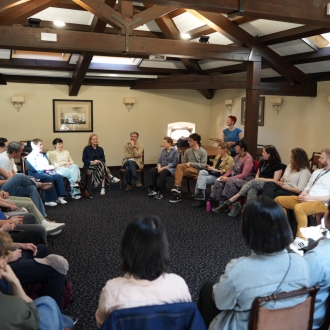
EAVE helped me enormously in shaping a communication strategy which worked. I would love to say now that EAVE just gave me the blueprint for success, but it wasn't like that. There are no keys to the kingdom which EAVE unlocks, only hard work and perseverance. So, the absolute biggest gain was the network, and the camaraderie - finding access to such a diverse group of filmmakers and producers, and getting their honest feedback on the project. When you're deep inside your own film, you develop blind spots, and you become biased. Being able to talk openly with fellows and hearing their perspectives is crucial. Films really are a collaborative effort, and EAVE gave us the tools and the connections to help make that real.
The film blends documentary with staged reenactments performed by the citizens of Rijeka. From a producer's perspective, did it create specific challenges compared to a more conventional documentary?
The entire process was a huge challenge because we were working with non-professionals, both in front of and behind the camera, trying to build something that had never quite been done before. And I wouldn't label it a documentary. It's a piece of cinema that captures a set of ideas and then chooses different approaches to present them - a strategy which, when I think about it, is what all great cinema does. What "Fiume o morte!" managed was to find layers of narrative that were genuinely unique and engaging.
That's also what I'd like to see more of in European film: the courage to peek outside the box, to be provocative, to choose themes that matter. There's so much shifting in the world right now. We have the platform, and with it - the responsibility to use it.

EAVE graduates Tibor Keser, Vanja Jambrović, Marina Gumzi
How did the audience resonate with the film, in and outside Rijeka?
It's the most-watched film ever in Rijeka, and the most-watched documentary of all time in Croatia. Art-kino Croatia, a local cinema in Rijeka, held over a hundred screenings, most of them sold out, more than any film before it. We couldn't have made this film without the people of Rijeka, and they feel that. They own it. I'm truly satisfied with that exchange.
What's in the pipeline for you next?
I'm juggling several films now, which is just the nature of the job. A few of them are pushing into hybrid territory, much like "Fiume o morte!".
One is "Foundations" by Srđan Kovačević — it deals with a very painful period in Split in the 1990s while my country was being torn apart by war. Our society doesn't seem to have the capacity to confront some of the injustices from those years, and we want to put a spotlight on that. Another is "A Boat in the Backyard" by Tonći Gaćina - a documentary comedy about a very Mediterranean (male) dream of owning a boat, at least once in your life, and what people are willing to sacrifice for it. It's funny and melancholic in equal measure, which I find irresistible. And then there's "Kolo" by Bojan Mrđenović, about a network of people trading in used bricks - material mined from the poorest parts of Croatia and sold to some of the wealthiest people looking to buy a piece of history. It sounds absurd, because it is.
If there's a thread connecting all of it, it's probably this: we have a platform, and with it a duty to speak about what matters. The moment I start doing the same thing day in and day out, I'll probably stop making films.
Page published 29 April 2026. Updated 30 April 2026.