“Disrupt the Default” - EAVE Interview with Tamara Dawit on Inclusive Production Practices
"One major idea was to disrupt the default. Just because something has always been done a certain way doesn’t mean it should continue."
By Lilla Kadar
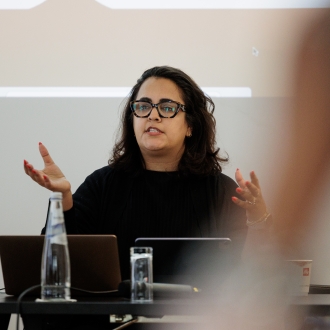
Tamara Dawit is a producer, EAVE graduate and consultant, and former funding executive with over 20 years of experience designing programmes and developing policies to stabilize and grow the creative sector. Through her company Gobez Media, she produces East African projects that advance narrative sovereignty, ethical collaboration, and diasporic exchange. Her films have screened at Cannes, TIFF, Tribeca, and Hot Docs, and broadcast globally on CBC, MTV, PBS, Al Jazeera, NHK, and ARTE.
EAVE sat down with Tamara to learn about Inclusive Production Practices, a brand-new EAVE training programme to embed equity, inclusion, and ethical practice across the full production lifecycle.
EAVE is launching a new on-demand training programme, Inclusive Production Practices, which you co-developed and co-curated with EAVE CEO Kristina Trapp. The workshop builds on the outcomes of the EAVE Impact Think Tanks on equity and inclusion in the production process. How did you conceive this EAVE on Demand?
Tamara Dawit: I’m really excited about this programme! It’s a great opportunity to step back from the traditional way we teach producing, and to look at the production process through a different lens, one that’s grounded in kindness – something that we talked about a lot in the EAVE Think Tanks. The industry is tough, producers often operate in survival mode, focused on keeping their companies afloat. This workshop encourages a shift: thinking not just about your own stability, growth and monetised success, but also that of your co-producers, your writers, and your directors. Are they going to become more stabilised, are they going to become stronger partners for you to work on your next piece of content?
It’s about pausing to reflect on what kind of journey we want toward the end result, whether that’s a film premiere at a festival or a series launch on a streamer or broadcaster. Can we make that journey more considerate, more collaborative? Ultimately, it’s about creating processes where everyone reaches the finish line stronger and more stable than when they started.
For me, those are the background ideas about why we created this programme: to really think with an eye of making everyone successful!
You mentioned stability across the team. How does that connect to inclusivity and long-term collaboration?
Stability across the team is key, in my opinion. Too often, collaborations between producers from high- and low-capacity countries are seen through a charity lens, as if one partner brings money and access, while the other only brings the story, and it is somehow undervalued. But if they work as genuine, equal and long-term partners, the lower-capacity producer gains experience, visibility, credit, and thus stronger access to money for future projects - and that will benefit the high-capacity producer as well. It’s about long-term thinking that benefits everyone.

As regards production practices, last year’s Think Tank report highlighted two crucial areas: development and financing. How will the training reflect these two areas?
In development, it’s about safeguarding stories, ensuring you’re not producing extractive content and that you collaborate respectfully with the communities involved. In financing, it’s about recognising and monetising the value of story and IP development, even when that work wasn’t financed externally. The training will explore these two areas, and it will guide producers through rethinking their projects from development to financing plans and budgets, using a mix of plenary sessions, group discussions, and case studies, much like other EAVE programmes.
What other key principles from the Think Tank inspired this training?
One major idea was to “disrupt the default.” Just because something has always been done a certain way doesn’t mean it should continue. EAVE has always helped producers build capacities and advocate for themselves and their peers in front of guilds, unions, funders or policy makers. This training extends that: encouraging producers from high-capacity countries to advocate for their lower-capacity partners when needed, if they really want to build content in an inclusive way. I think when we do that extra work, we end up with content where everyone, the whole team is equally valued and equally benefitting, and they leave with a good experience.
Sometimes inclusivity means small but impactful actions. For example, if a director from the Global South is editing in Canada or in Europe, do we budget for a translator or someone from that ethno-cultural community to help bridge differences, to help them communicate effectively with the colourist, the sound editor or the composer? How are we making sure of getting the best content, if we don’t do that? So that’s a very small thing, but it can become a really big thing, if there is a communication breakdown. These details ensure that everyone can contribute fully, leading to better results and healthier collaborations.
What long-term impact do you envision?
I hope it will normalise equitable co-productions, stabilising all partners. When everyone benefits, the global production ecosystem grows more balanced and sustainable. We need to move away from the idea that collaborating with the rest of the world is an act of favour, and having this hierarchy of who is more able to produce or more important on the spectrum. Every partner brings unique value, whether that’s access to a great story, a great location, an authentic community, whatever it is.

Who is the training for, and when should producers apply it in their project timeline?
Important to mention that this isn’t a programme for low-capacity or marginalised producers — it’s for everyone in the industry. It’s about learning how to “play nicer in the sandbox together.” If we want inclusion at the end, we have to plan for it from the very start, and that means valuing access, creativity, and community the same way as valuing money.
It’s primarily for producers, like most EAVE programmes. My recommendation is that this type of workshop works best in development. It’s the ideal time to join because that’s when key decisions about partnerships, financing, and budgeting are still being made. If you are doing this sort of design thinking exercise with your project, then in its initiation and growth phase you will be able to include all of those things, down the road. Participants will apply the learning directly to their projects, using the workshop to address real challenges.
The training can also be valuable for institutions and funders, or it could be part of market offerings. For example, understanding what inclusive production entails, such as why a “cultural authenticity steward” might be a necessary budget line, can help a funder to support projects to be more equitable.
Would European-only producers also benefit from inclusivity training?
Absolutely. These principles apply everywhere. For example, within Europe there can be imbalances between experienced producers and first-time directors, or established and emerging co-producers. Often, we see things that come up with crediting, like someone will bring me on as an emerging producer and they will credit me as associate producer, but that credit will not enable me to access the funding on my own next time. The workshop encourages producers to design collaborations that build everyone’s career stability.
We often worry about the idea of scarcity, such as limited funding, limited sales companies, limited slots at A-list festivals, but I think that as producers grow and companies stabilise, this also develops more distribution companies, and more markets in other parts of the world, as well as new sources of revenues. As public funding declines, we need to have new ways to collaborate, to think differently on how to approach and monetise things, because it may enable us to have a wider reach and better outcome.

Find out more about the EAVE Inclusive Production Practices – available to book from 2026!
https://eave.org/programmes/inclusive-production-practices
Download the information package here.
For more information, please contact EAVE Project Manager Théo Koutsaftis theo@eave.org.
Page published 15 December 2025. Updated 19 December 2025.

Previous: 5 December 2025
Creative Producer Indaba selection announcement
15 Filmmakers Gather at Creative Producer Indaba to explore African Film Content Creation
15 December 2025
EAVE Interview
“Disrupt the Default” - EAVE Interview with Tamara Dawit on Inclusive Production Practices
Next: 17 December 2025
Time to celebrate: Introducing the 2026 EAVE Producers Workshop Participants!